

STOP THE BLEED® Equipment: What to Know Before You Buy
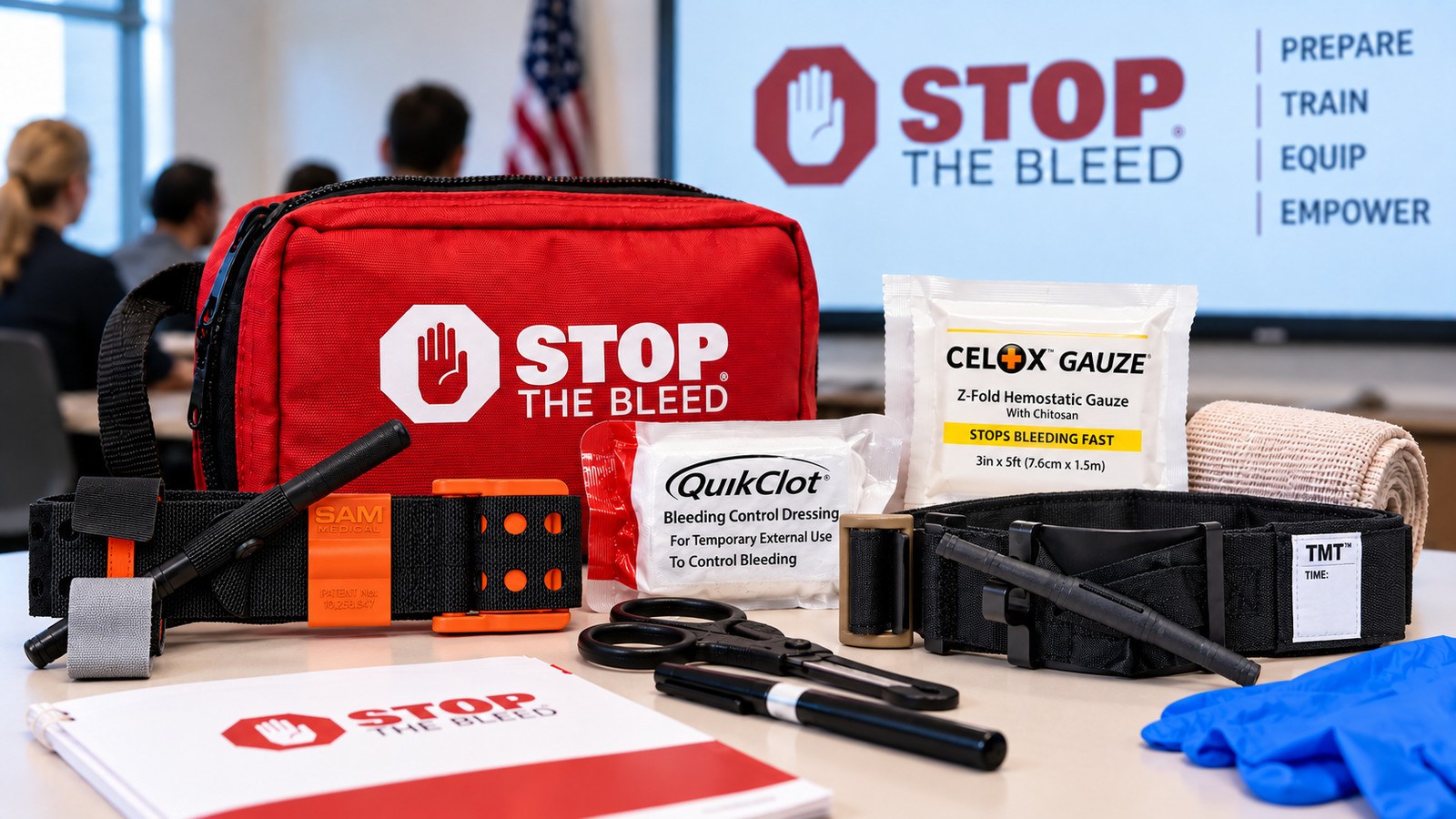
A short guide for anyone who has taken the class, or plans to, and wants a kit within reach if it is ever needed.
In short: STOP THE BLEED® kits come in three fixed configurations, contain only devices the program has reviewed and accepted, and can be sold only by companies licensed by the Department of War. Before you buy, check the name, the assembler, the seller, and the device labels. The full details are on the STOP THE BLEED® Equipment page.
You will probably open a STOP THE BLEED® kit only once, on the worst day of somebody’s life. A person with life-threatening bleeding can die in as little as five minutes, often before an ambulance arrives. That is why the class exists, and it is why the equipment matters as much as the training. If you have taken the class, or you are responsible for a school, a workplace, a church, a gym, or a car full of kids, here is what to know before you buy.
Is STOP THE BLEED® the same as “bleeding control”?
“Bleeding control” is an ordinary phrase, and a lot of products use it. STOP THE BLEED® is different. It is an official program of the U.S. Department of War, built on two decades of combat casualty care research and the battlefield practices that reduced preventable death from hemorrhage in Iraq and Afghanistan. A kit that carries the STOP THE BLEED® mark is held to that standard. A kit that doesn’t is held to whatever standard the seller picked.
Which STOP THE BLEED® kit do I need?
Every STOP THE BLEED® kit is one of three named configurations. The names do not change.
Basic Kit. A tourniquet, plain gauze for packing, a compression bandage, gloves, and a marker. For bleeding from an arm or leg. This is the kit for an office, a classroom, a home, or the wall cabinet next to an AED.
Intermediate Kit. The same, except a hemostatic (clotting) dressing replaces the plain gauze. That matters for wounds at the neck, shoulder, armpit, or groin, where a tourniquet will not work. Think factories, construction sites, rural schools, farms, and anywhere an ambulance takes a while.
Advanced Kit. Adds a vented chest seal. This one is for organizations whose responders are trained beyond the STOP THE BLEED® class: police, security teams, and event medical staff.
If a kit is called anything else, whether “Trauma Kit,” “Pro Kit,” or “Premium Bleeding Control Kit,” it is not a STOP THE BLEED® kit, whatever the packaging looks like.
Who decides what goes in a STOP THE BLEED® kit?
A licensed company can pack more of something, and can add trauma shears or a rescue blanket. It cannot leave out a required item, swap in a tourniquet or dressing the program has not accepted, or invent a new kit. That is the difference between a kit built to a standard and one built to a price.
How are the tourniquets and dressings chosen?
The program’s reference is the Department of Defense Committee on Tactical Combat Casualty Care, the body that reviews the evidence on battlefield trauma care and publishes a list of recommended devices. STOP THE BLEED® tourniquets come directly from that list. Hemostatic dressings are reviewed by the program and accepted only if a member of the public can use them with the training the class provides. Every tourniquet and dressing sold under the mark has been reviewed and accepted, and each one is a medical device regulated by the U.S. Food and Drug Administration.
Four tourniquets are accepted. Three hemostatic dressings are accepted. Nothing else may be packed in a STOP THE BLEED® kit. The equipment pages show all of them and explain what sets each one apart.
Who can sell STOP THE BLEED® kits?
A company has to be granted a license by the Department of War before it can sell STOP THE BLEED® equipment. The list of licensed sellers is published on the Equipment page. If a seller is not on it, the kit is not licensed, whatever the listing says.
How do I know if a STOP THE BLEED® kit is real?
Lookalike kits are common, and some are very good at looking like the real thing. Here is how to tell them apart in a few seconds. A longer version is on the Verify a kit page.
The mark comes first. The name is STOP THE BLEED® followed by Basic, Intermediate, or Advanced. A company name in front of the mark, or any other word after it, means it is not licensed.
Look for “Assembled by.” Every licensed kit names the company that assembled it. No single company makes all the components, so “Manufactured by” on a kit is a sign to look closer.
Check the seller against the licensed list.
Read the device labels. The tourniquet and any hemostatic dressing must be ones the program has accepted.
If a kit fails any of these, it is not a STOP THE BLEED® kit.
Is there such a thing as a government-approved kit?
There is no such thing as a “government-approved kit” or an “FDA-approved kit.” The devices inside a kit are regulated by the FDA. The kit itself is not approved or certified by anyone. What a kit can be is licensed by the Department of War to carry the STOP THE BLEED® mark. A seller who claims otherwise is telling you something about the seller.
Are counterfeit tourniquets a real risk?
Counterfeit copies of the accepted tourniquets are widely sold online, and they can fail under load. Buying from a licensed seller is the simplest protection. If the price looks too good or the packaging looks off, trust that instinct.
Do I still need the class if I have a kit?
What is in the kit is what the class teaches you to use. Plain gauze, packed correctly, works. A hemostatic dressing works better in the hands of someone who has practiced. A tourniquet works when it goes on high, tight, and fast. None of that comes in the box. If you have not taken the class, take it. If it has been a while, take a refresher.
Where do I start?
Everything above, with the full list of licensed sellers, the three kit configurations, the accepted tourniquets and dressings, and a page on how to spot a lookalike, is on the STOP THE BLEED® Equipment page. Start there before you buy.
STOP THE BLEED® is a registered trademark of the U.S. Department of Defense.